
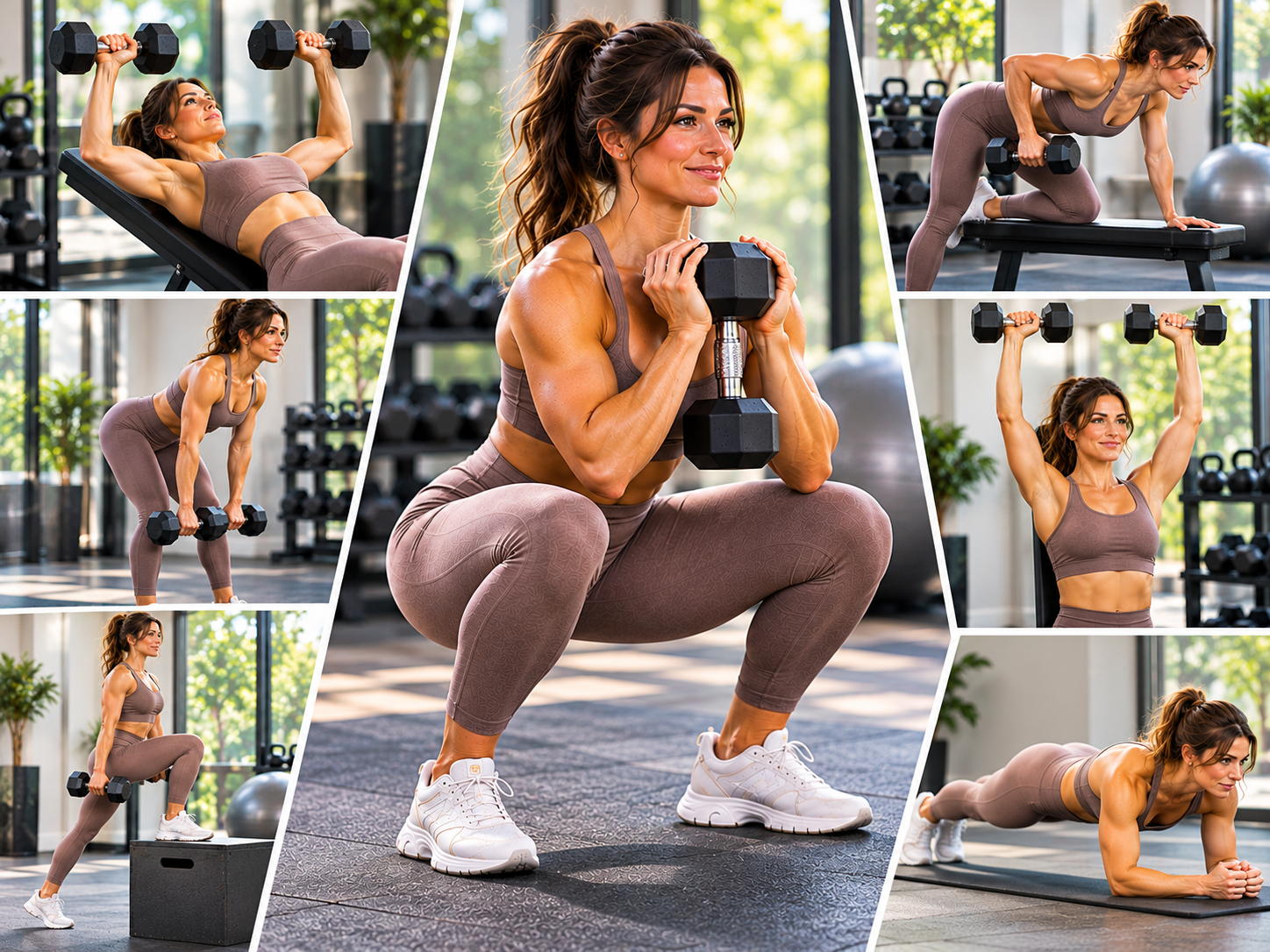
When it comes to strength training, it’s easy to assume that more exercises mean a better workout.
You might see workout routines featuring 10, 12, or even 15 different exercises and wonder whether you’re doing enough.
But here’s something I’ve learned from more than 30 years of training clients: An effective strength workout doesn’t need to be complicated or filled with dozens of exercises.
In fact, for many people, just 5–8 well-chosen exercises can provide an excellent full-body strength workout.
The key is choosing exercises that work together to train your major muscle groups effectively.
Why More Exercises Doesn’t Always Mean Better Results
Strength training works by challenging your muscles enough to encourage them to adapt and become stronger.
But that doesn’t mean you need a separate exercise for every individual muscle.
Many traditional strength exercises work multiple muscle groups at the same time.
For example:
- Squats strengthen your legs and hips.
- Chest presses train your chest, shoulders, and triceps.
- Rows strengthen your back and biceps.
- Deadlifts challenge your hips, legs, and back.
- Overhead presses train your shoulders and triceps.
By selecting exercises that involve multiple muscle groups, you can accomplish a great deal without making your workout unnecessarily long.
The goal is to train your muscles effectively—not to perform as many different exercises as possible.
How Many Exercises Should You Include?
For a typical full-body strength workout, I generally recommend starting with 5–8 exercises.
That provides enough variety to train the major muscle groups without making the workout overly complicated.
Here’s a practical way to think about it:
3–4 exercises: A shorter workout that can still be effective when you focus on major movements.
5–8 exercises: An excellent range for a balanced, full-body strength routine.
9 or more exercises: May be appropriate for specialized goals, but isn’t necessary for most general fitness programs.
Remember that exercise selection is only part of the equation. The number of sets, repetitions, resistance used, and effort you put into each exercise also influence your results.
Focus on Movement Patterns, Not Just Muscles

Rather than choosing exercises randomly, I prefer building workouts around fundamental movement patterns.
These movements help ensure you’re training your body in a balanced and practical way.
A well-rounded strength workout might include:
- Squat: Goblet squat or leg press
- Hip hinge: Romanian deadlift or hip bridge
- Push: Chest press or push-up
- Pull: Dumbbell row or seated cable row
- Overhead movement: Shoulder press
- Single-leg movement: Step-up or reverse lunge
- Core stabilization: Static or dynamic-style plank
You don’t need a separate exercise for every movement pattern in every workout. Many exercises train multiple muscle groups and movement patterns, so your choices can vary depending on your goals, abilities, and equipment.
What matters is that your overall training program provides balanced coverage of the major muscle groups.
What About Sets and Repetitions?
Once you’ve selected your exercises, the next question is how much of each one to perform.
For many general fitness routines, a practical starting point is:
- 2–3 sets per exercise
- 8–12 repetitions per set
- Resistance that feels challenging while allowing good technique
- Adequate rest between sets to maintain exercise quality
These aren’t rigid rules. Your ideal sets and repetitions depend on your goals, training experience, and the exercises you’re performing.
A beginner may benefit from starting with fewer sets, while someone with more experience may need additional training volume.
The important thing is to challenge your muscles appropriately and gradually increase the demands as you become stronger.
Do You Need to Change Exercises Every Workout?
Definitely not.
One of the biggest mistakes I see is changing exercises so frequently that there’s little opportunity to improve at them.
Repeating the same foundational exercises allows you to develop better technique, track your progress, and gradually increase resistance or repetitions.
This is an important part of progressive overload—the process of gradually challenging your muscles as they adapt.
You can certainly introduce variety, but you don’t need an entirely different workout every time you train.
Consistency with effective exercises often produces better results than constantly chasing variety.
How to Build a Simple, Effective Strength Workout
If you’re unsure where to start, keep things simple.
Choose one exercise for each major movement pattern, then add another movement or core exercise if appropriate.
For example, a full-body workout might include:
- Goblet Squat — 2–3 sets
- Dumbbell Romanian Deadlift — 2–3 sets
- Dumbbell Chest Press — 2–3 sets
- Seated Cable Row — 2–3 sets
- Dumbbell Shoulder Press — 2 sets
- Step-Ups — 2 sets
- Plank — 2 sets
This routine covers your major muscle groups without requiring a long list of exercises.
For many adults, performing a balanced full-body routine two or three times per week, with appropriate recovery, can provide an excellent foundation for improving strength and fitness.
Nate’s Trainer Tip
After more than 30 years of personal training, I’ve found that exercise quality and consistency matter far more than exercise quantity.
Don’t judge a workout by how many exercises you completed.
Instead, ask yourself whether you trained the right muscles, used appropriate resistance, maintained good technique, and challenged yourself enough to make progress.
Five well-executed exercises can be more productive than ten performed without a clear purpose.
What’s the Main Takeaway?
You don’t need a long, complicated exercise list to build strength.
For many people, 5–8 carefully selected exercises can provide everything needed for a balanced full-body workout.
Focus on fundamental movement patterns, use appropriate resistance, and gradually challenge yourself as you become stronger.
Remember, effective strength training isn’t about doing more exercises.
It’s about getting more benefit from the exercises you do.
Keep Learning
- How Much Strength Training Do You Really Need Each Week? — >read
- What Is Progressive Overload—and Why Does It Matter? — >read
- What Is Functional Strength—and Why Does It Matter as You Age? — >read
Explore Home Gym Essentials
Looking for practical equipment to build an effective strength-training routine at home? Explore my curated Home Gym Essentials for versatile equipment that helps you get more from every workout.
ABOUT THE AUTHOR

Nate Hartwig
Certified Personal Trainer
Certified Nutrition Coach
Certified Strength & Conditioning Specialist
Nate has spent more than 30 years helping people improve their fitness through practical, sustainable exercise and healthy lifestyle strategies. My Radiant Vitality brings that experience together with carefully selected products and tools designed to support healthier everyday living.
Leave a Reply